Sit Down First: Why the Smartest UK Nights Out Now Begin With One Slow Drink
Photo: mike connor, CC BY 2.0, via Wikimedia Commons
Half eight on a Saturday and the bar is three deep. Someone is shouting an order over a speaker that nobody has thought to turn down, a card machine is being passed over heads, and you are holding a coat, a bag and a phone while trying to work out what six other people want to drink. Nobody is having a good time. Everybody is pretending to.
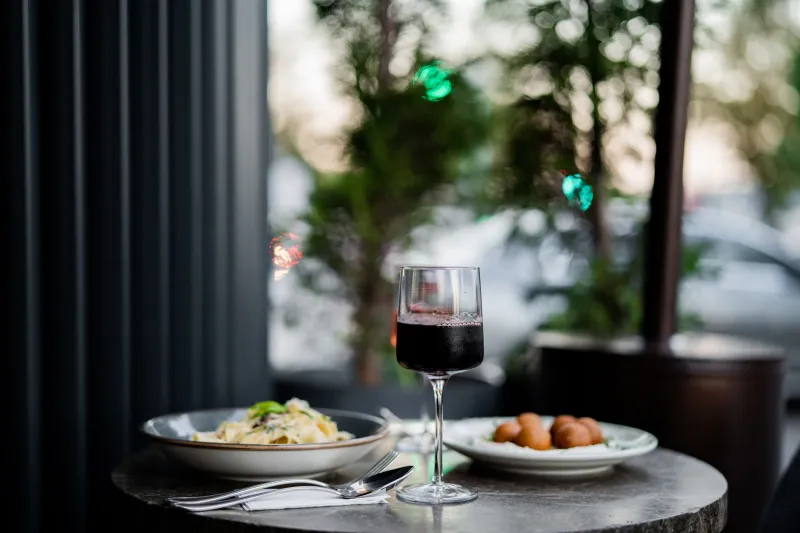
Now picture the alternative. Half seven, a table booked two weeks ago, two seats and a bowl of almonds. One drink arrives, properly made, in a glass that hasn’t been stacked in a dishwasher at the wrong angle. You talk. Then, at some point around nine, you decide what the rest of the evening looks like — a gig, a proper dinner, dancing, or another hour exactly where you are.
That shift, from scramble to seat, is the most interesting thing happening in UK nightlife right now. It is not nostalgia and it is not a retreat from fun. It is a quiet correction.
The scrum we’ve stopped enjoying
The standing-at-the-bar start to an evening made sense when drinks were cheap and rooms were smaller. It stopped making sense for a lot of people somewhere around the point when a round for four started costing more than a main course and the group chat became a negotiation about who was where and when.
There is also the simple fact of noise. Rooms built for late-night volume are increasingly opening at seven and playing as though it’s already midnight. Shouting your order is one thing; shouting your way through the only hour of the week you get to properly catch up with friends is quite another.
The result is that people have started booking. Not just dinners — tables. In London, Manchester, Bristol, Birmingham and Glasgow, lounges that once kept half the room for walk-ins are now taking reservations from early evening, and the good slots go early in the week.
What a seated hour actually looks like
Forget anything fussy. A seated cocktail hour is not a tasting menu with a sommelier and a lecture. It is a table, a short drinks list, a small snack menu and enough space to hear the person opposite you.
In practice, most people are booking somewhere between seven and half eight for a ninety-minute window, ordering one drink each and a couple of things to pick at, and then deciding what happens next. Some stay for a second round. Some move on. A surprising number end up staying exactly where they are, because the room was better than whatever they’d planned.
The crucial detail is that nothing is rushed. The whole point is that the first hour isn’t a staging post before the real evening — it is part of it.
Why mixed groups get on better sitting down
This is the argument that wins people over. Groups are messier than they used to be. One friend is on a tight budget, another has a 7am start, a third has stopped drinking, a fourth will absolutely be dancing at one in the morning. The bar scrum punishes every one of those differences, because it ties the group to a single round and a single pace.
A table equalises it. Everyone orders what they want at their own speed. Nobody is carrying six pints across a crowded room and nobody is stuck at the bar while the conversation happens without them. The person on a soft drink isn’t the odd one out; they’re just holding a different glass.
The sober-curious fit
It would be dishonest to pretend this shift has nothing to do with the way Britain’s drinking habits are changing. The alcohol-free options in a good bar in 2026 bear almost no resemblance to the sugary imitations of five years ago — distilled botanical spirits, fermented drinks, sherry-style zeros, proper low-ABV aperitifs.
But the more important change is structural. When the drink is not the activity — when it is the accompaniment to a table, a conversation and a couple of hours — the pressure to have one with alcohol in it quietly evaporates. A seated hour gives a no-ABV drink somewhere to belong.
Atmosphere without the cattle prod
Bars have had to learn how to hold a room at half seven without pretending it’s half eleven. The ones doing it well tend to share a few habits. The lighting comes down slowly rather than arriving at full darkness. The music sits at conversation level and climbs through the evening. Water arrives without being asked for. The snack list is short and useful. And, most importantly, nobody hovers — staff let a table be a table, rather than turning it every forty-five minutes.
The ones getting it wrong are usually obvious from the door: a hard ninety-minute cut-off policed by a card authorisation, a tablet shoved in your face before you’ve sat down, an upsell that arrives before the greetings, and a sound system at eleven o’clock volume at quarter past seven. Atmosphere can’t be forced. It has to be given room to develop.
Building your own slow start
A few practical notes from people who do this every week. Book for seven fifteen rather than eight thirty — the earlier slot is the one that buys you the whole evening. If you can’t get a table, take two seats at the bar and do the same thing; the principle matters more than the furniture. Agree a no-rounds rule before you arrive, and stick to it. Choose a venue with a short, confident drinks list over one with forty pages and no point of view. Pick your second stop within a ten-minute walk rather than a taxi ride, so the evening doesn’t hinge on a booking at half nine. And decide in advance that it’s fine to go home at eleven.
There is also something to be said for the quiet exit. The best nights rarely end with a scramble for the last train; they end with someone saying, genuinely, that they’ve had enough and everyone else agreeing.
The case for going slower
None of this is an argument against late nights. It is an argument for starting them properly. The UK’s best bars have always understood that hospitality is about pace — handing the evening over to the people in the room rather than marching them through it.
So book the table. Order one drink. Sit with it for a while. The night has plenty of time to get loud later, and it will be better for the wait.